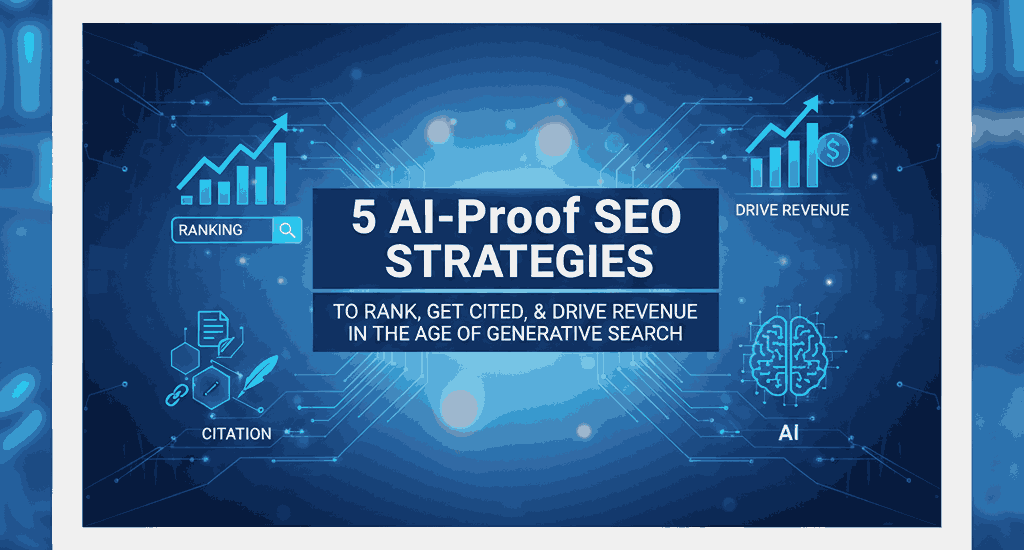
AI-Proof SEO Strategies
By 2026, most searches will be answered by AI before anyone even clicks on your site. This means that even if you’re ranked number one now, your traffic could decline. So today, I’m sharing five strategies you need to rank and stay relevant in this new AI-powered search reality. Let’s get started.
Strategy 1: Focus on Entities and Topical Depth, Not Just Keywords
Here’s something that might surprise you: If your traffic is still declining after SEO, this is probably the reason.
A recent study analyzed over 1,500 Google search results and found no consistent correlation between keyword density and ranking. In fact, higher-ranking pages had lower keyword density on average.
So what does this mean for you?
Google’s AI isn’t just looking for pages that mention a keyword 20 times. It’s looking for pages that understand how ideas connect, relate, and build on each other.
Think of it like this: You’re in a meeting. It’s easy to tell who’s just throwing around buzzwords versus who actually knows their job, right? AI works the same way. It instantly recognizes surface-level content and rewards those who demonstrate genuine expertise.
How to do it:
1. Create Topical Depth
Build a pillar page, say, a complete guide to running shoes, and link to subtopics like:
- Best running shoes for flat feet
- Trail running shoes
- How cushioning prevents injuries
This interlinking signals to Google that you thoroughly understand the topic, making you a trusted authority and boosting rankings across related pages.
2. Use Semantic Variety
Tools like Surfer SEO and Google’s NLP API reveal the concepts and entities Google associates with your topic—brands, locations, technologies, people. Incorporate these naturally into your content so AI can understand your subject in context.
But there’s a layer of authority most people overlook. Without it, your content will always struggle to gain visibility.
Strategy 2: Build Author and Brand Authority
Most marketers tell you to create good content, and that’s solid advice. But have you noticed that even your best content sometimes gets zero traction?
Here’s why: Average content from an authority almost always outperforms great content from an unknown.
A famous psychology study found people were twice as likely to follow instructions when the speaker wore a doctor’s coat, even if they weren’t a real doctor.
AI algorithms mimic this human bias. They rank and quote content from well-known authorities because trustworthiness reduces risk for both the platform and the user.
Google’s AI Overviews don’t just ask what the page says, they ask who said it and whether it can be trusted. Just like you wouldn’t take medical advice from a random stranger online.
How to build authority:
- Get featured on podcasts, industry blogs, or news outlets.
- Earn online mentions; these strengthen your “authority footprint.”
- Our data shows: when companies are quoted on news or niche industry sites, AI platforms cite them far more often.
The most quoted content? Blogs, news articles, and industry publications—all forms of consistent, credible publishing.
Strategy 3: Optimize for Featured and Summarized Results
Number-one ranking blog posts are losing traffic right now, because people aren’t searching as they did four years ago. AI is answering their questions before they ever click. And here’s what everyone gets wrong:
They look at analytics and say, “AI isn’t driving traffic.” Well, duh, it’s not supposed to. But here’s what they miss: AI is driving conversions. In a study of companies investing in both traditional SEO and AI optimization:
- AI platforms drove less than 1% of traffic
- But they were responsible for 9.7% of revenue in B2B and 11.4% in B2C
Why? Because people use AI for top-of-funnel research. Most aren’t ready to buy, but a small, high-intent segment is.
About 14% or more end up purchasing, some in-store, some directly on your site. In B2B, it’s mostly direct website visits.
This conversion channel doesn’t show up in standard analytics because users research on AI platforms before visiting your site.
Think of AI-powered search as a conversation, not a search engine.
When someone asks a question, AI doesn’t list websites; it quotes them.
How to get quoted:
- Write as if you’re answering a direct question
Example:
Q: “What are the best SEO tools for beginners?”
A: “Ubersuggest, Ahrefs, SEMrush, and Google Search Console. They’re easy to use and scale as you grow.”
This format is AI-friendly and easy to extract.
- Structure for scanners
Use short paragraphs, bullet points, and clear subheadings.
If a human can skim it, AI can summarize it.
Well-structured content is AI catnip. - Target “People Also Ask” questions
These feed directly into AI summaries. Each question is a citation opportunity—and when you’re cited, you get high-intent users who convert.
Pro Tip: If you want to appear in Google’s AI Overviews, focus on facts, comparisons, and clear data. That’s what they cite most. But getting quoted is only half the battle. If AI can’t read your content easily, it’ll skip you, no matter how brilliant your answer is.
Strategy 4: Feed the Machines, Structured Data, and AI-Friendly Content
Most marketers don’t fully grasp this:
AI doesn’t automatically select the “best” content. It skims, just like humans.
Imagine walking into a library:
- Most books are unmarked piles of paper, no titles, no chapters.
- One book has a clear table of contents, headings, and a summary.
Which do you grab when you need an answer fast?
AI does the same thing. If your content lacks structure, it’s treated as low-quality noise.
Here’s the shift:
- Traditional SEO = links, keyword relevance, content quality
- AI SEO (or GEO/AEO) = structure, citations, clarity, sentiment
AI cares less about backlinks and more about whether your content is easy to parse and trustworthy.
How to optimize for AI readability:
- Use Schema Markup
Add FAQ, How-To, and Review schema.
Schema is like a nutrition label for your content—it tells AI exactly what your page is about. - Add Multiple Formats
Include videos, images, infographics, and charts.
AI prefers multimodal data; it signals depth and clarity.
Our data shows: blogs with visuals and data visualizations get cited far more often. - Surface Key Data Clearly
Use numbered lists, stats, and tables.
Don’t bury insights in long paragraphs.
AI platforms crave facts, stats, and original research—they use this more than anything else.
But none of this works if you treat SEO as a one-time task.
Strategy 5: Rethink Your SEO Workflow for Generative Search
In the past, keyword stuffing and annual content updates kept you ranking.
Today, that’s obsolete.
If you’re not actively training AI to think like you, it’s quoting your competitors.
Think of AI like a parrot:
- If you speak clearly and consistently, it repeats you.
- If you mumble, switch topics, or stay silent, it learns from everyone else.
How to train the AI “parrot”:
- Track AI Visibility, Not Just Rankings
Monitor how often your content is referenced or cited in AI summaries.
This is your new KPI. You can do this for free with Ubersuggest’s AI Visibility Report (ubersuggest.com). Companies using this saw 5.8% of total online sales come from AI platforms like ChatGPT within 12 months. - Test Your Summaries
Paste your post into ChatGPT, Perplexity, or Claude and ask: “Summarize this.” If key points are missed or distorted, rewrite for clarity. - Create Recognizable Patterns
Ditch vague slogans. Build signature frameworks, phrases, and visuals that AI can recognize and quote. When we help brands develop unique terminology, AI starts repeating their language, boosting brand attribution.
Blogging Isn’t Dead, It’s Evolving
You’ve probably heard: “Blogging is dead.” People say traffic is down, so they stop publishing. But here’s the truth:
If you don’t blog, you won’t appear in AI answers. When we analyzed which sites AI platforms cite most, the answer was clear:
Blogs
News sites
Product blogs
LinkedIn articles
All forms of structured, authoritative, frequently updated content.
Yes, organic traffic from traditional search may dip. But companies that kept blogging saw higher AI visibility, more citations, and, most importantly, increased revenue. Revenue matters more than traffic. And AI is already driving real sales, quietly, invisibly, but powerfully.
What’s Next?
Understanding AI visibility is just the start. The real shift is happening inside Google itself, and it’s about to reshape organic search, paid ads, and how customers find you.
Need help getting quoted by AI? My team at Digital Gathri helps brands optimize for generative search and maximize AI-driven revenue.
General FAQs
AI-powered search optimisation means tweaking your content so platforms like Google AI Overviews, ChatGPT, and Perplexity can actually read it, understand what you’re saying, and, if you’re lucky, mention your site in their responses.
The old way of doing SEO is all about keywords and backlinks. That’s fine for regular search, but AI search cares way more about things like entities, authority, how you organize your info, and whether you’re being clear. Even if your page ranks high in Google, AI might just skip over you if it doesn’t see what it needs.
AI likes sites that spell things out clearly, use structured formatting, share solid facts, and show trust think authority, real citations, and schema markup. If your content checks those boxes, you’ve got a shot.
Give straight answers. Use schema markup. Lay things out under clear headings. Toss in some stats. Cover the “People Also Ask” questions too. The easier you make it for AI to grab and double-check your info, the better your chances.