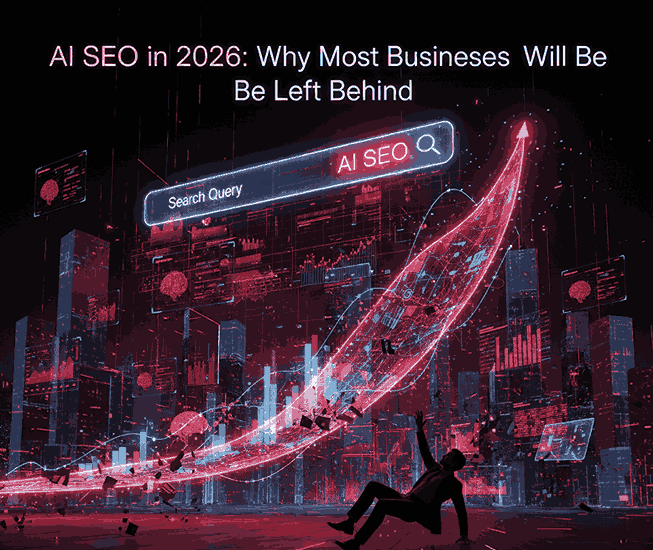
If you don’t know this, you’re going to be left behind. In 2026, AI isn’t just changing SEO, it’s rewriting the entire playbook. Next year, forget about cramming keywords or chasing backlinks. What really matters is how AI figures out what people actually mean when they search, and which brands it trusts to provide real answers.
I’m Govind Nigrawal. In this blog, I’ll share the biggest AI SEO trends I’ve witnessed, things that are changing the way people search, click, and buy online. Let’s get started.
1. Brand Citations Are Replacing Backlinks
For two decades, SEO has relied on backlinks. The more links your site has, the higher your rankings will be. Simple, right? But here’s the thing: In 2026, the value of backlinks is declining. They’re being replaced by something called brand citations. Now, if you’re still chasing backlinks the old-fashioned way, you’re actually wasting time and money. Here’s why.
In the old world, you could convince bloggers and regular sites to put your links everywhere, and that was enough to rank well. But AI has completely changed the game. When someone asks Perplexi, “What’s the best email marketing platform?” it doesn’t just show you a list of who has the most backlinks. Instead, it mentions brands in context. A typical answer looks like this. Mailchimp is known for its ease of use, and it offers more advanced automation than some other options.
Brands that focus on generating high-quality citations now will dominate in 2026. And those still focused on building backlinks will see their traffic and revenue disappear.
2. Reddit & Quora Are Losing AI Ranking Power
Reddit and Quora used to be SEO goldmines. Not anymore. And what’s replacing them is changing everything. This is a fact. When it comes to AI search results, helpful comments on community forums are no longer useful. Yes, they can help a little, but they don’t dominate like they once did. According to a Contensify HQ B2B SAS trend report, community platforms like Reddit and Quora are becoming saturated, and AI tools are actively shifting toward verified expert authority-based content.
Why? These platforms are so easy to manipulate with bots and fake engagement. Now, when ChatGPT answers a medical question, it doesn’t quote a Reddit thread with 500 upvotes. He prioritises an authentic article from a real medical professional with verified credentials.
The AI is asking these important questions:
- Who wrote it?
- What are their credentials?
- And where else have they been quoted?
A comment from a random user will never be able to compete with verified industry experts on authentic domains. So, you need to act now.
- First, stop relying on community platforms for SEO. They are rapidly outweighing the AI.
- Second, publish on industry-specific, authentic sites and trade publications where AI systems actually seek expertise.
- Third, publicly establish your credentials with verified bylines, author bios, and professional certifications.
The AI is actively scanning for these trust signals. Having authority across topics will help AI build your site, but you also need to understand that the entire transaction model is changing.
3. LLMs Are Becoming the New Conversion Engines
The goal of SEO has always been simple: drive traffic to your website. The more clicks, the better. But AI platforms are making changes that will make website traffic irrelevant when it comes to converting visitors into buyers. In September 2025, OpenAI partnered with Stripe to launch instant checkout directly within ChatGPT.
Now, when you ask ChatGPT to find me a handmade leather wallet, it shows you options from Etsy and Shopify merchants, and you can complete the entire purchase without leaving the chat interface. Think about that for a second. Search Engine Land’s August 2025 report showed a 527% increase in AI-referred sessions. But here’s an important point most people don’t understand.
These numbers show that AI platforms are becoming traffic sources themselves, not referral engines. Facebook created lead ads to keep users within Facebook. Instagram created in-app checkout to prevent you from leaving. Now, AI platforms are doing the same thing, but faster and more conveniently. When ChatGPT can process payments, book appointments, or handle signups without you having to click a link, why would it send you elsewhere? But that doesn’t mean sales are dead for website traffic. You just need to adapt.
Here’s how.
- First, stop thinking of AI as a referral source. It’s a sales channel. Your brand needs to be within these platforms, not just mentioned by them.
- Second, optimise for on-platform conversions. Integrate with the commerce systems these AI platforms are building, like the ChatGPT Stripe integration.
- Third, track your AI native conversions separately.
Most analytics won’t show you when someone converts within the AI interface. And speaking of conversions, another big change is coming.
4. AI Ads Will Replace Organic Conversions
Remember when Google Search only had 10 blue links? Then came Google Ads, and suddenly you had to scroll through a few ads to see organic results. Click-through rates plummeted. Businesses had to pay just to be seen. Well, the same thing is going to happen within ChatGPT and every other AI platform. According to Search Engine Land, OpenAI is preparing to launch its own ad platform in 2026. They are actively hiring ad executives and building an entire monetisation team dedicated to conversational AI.
As ads become dominated by AI responses, organic brand mention visibility will decline. Brands that rank highest in AI searches in 2025 will see their visibility decline by 2026 unless they pay for them, just like traditional SEO did on Google. Yes, you can still get organic traffic, and it’s still valuable, but a significant portion of searchers will click on paid ads.
So, here’s what you need to do to benefit from this AI ads approach. First, maximise your organic AI visibility before ads launch. Build your brand authority and citation profile where organic placements still matter. We covered this in trends one and two. Second, allocate 10 to 15% of your current ad budget to AI platform testing.
When ChatGPT ads launch, you’ll want to have capital ready to purchase initial inventory at a low price. Meanwhile, Google has begun rolling out its AI-powered ad products. So, you can launch ads in the Google AI overview right now. Third, when these platforms launch, test early. Early adopters always offer better performance and lower prices before the auction becomes competitive.
Businesses that prepare now will dominate paid placements. But there’s another trend that’s even more important.
5. Voice-Based AI Search Is Creating Winner-Take-All Markets
In voice-based AI search, ranking number one is the only position that matters. When someone asks their car’s AI for the best plumber near me, only one brand is recommended. The other doesn’t exist. The more people use AI, the more visibility is limited to a small segment of the market. And we’re already there. Apple is integrating advanced AI search into Siri. Voice integration is rapidly spreading across homes, cars, wearables, and devices everywhere. This is a major shift in how the market works.
So what do you need to do now? First, optimise for voice queries. Voice searches are based on conversational questions.
Your content should directly answer what’s best in your niche and who I should use for what kinds of questions. Second, dominate your category positioning. You can’t be a good option. You must be the definitive answer. AI only recommends the most trusted brands. Third, test your AI voice visibility now. Ask ChatGPT, Siri, and voice assistants the questions your customers will ask.
If your brand isn’t recommended first, you’re losing out. Voice-based AI search is creating a monopoly in every category. Brands that become the default answer in 2026 will begin to capture more of the market, especially as the new generation grows up and increasingly uses voice search instead of text-based search.
Bonus Trend: Keywords Are Dead – Topics Are King
If you ask an SEO expert in 2023 how to rank in email marketing, they’ll tell you to create a very detailed guide on email marketing. But in 2026, that strategy won’t save you because AI doesn’t read content like old Google SEO. More keywords no longer mean more relevance.
If anything, it could get you flagged as low-quality content. Numerous studies, and even what we see with our clients, show that SER success now depends on complete topic coverage and intent alignment. When someone asks about email deliverability, Google’s AI doesn’t just look at that phrase five times. It scans everything related to it: sender reputation, authentication, list hygiene, engagement metrics, and the entire topic. Businesses that create thin content targeting individual keywords will lose out.
So here’s how to avoid this:
- First, audit your content for topic coverage, not keyword density.
- Second, create larger content hubs that cover the entire subject, not individual posts targeting a single keyword.
- Third, structure your content using clear headers, structured data, and complete information to make it understandable to AI.
The AI SEO Revolution Is Already Here
Look, these five trends are just the beginning. The AI revolution in search is happening right now, and businesses that embrace it will dominate their markets. Those who don’t will be left wondering what happened.
But the point is, it only works if you know how to audit your content for AI readiness.