
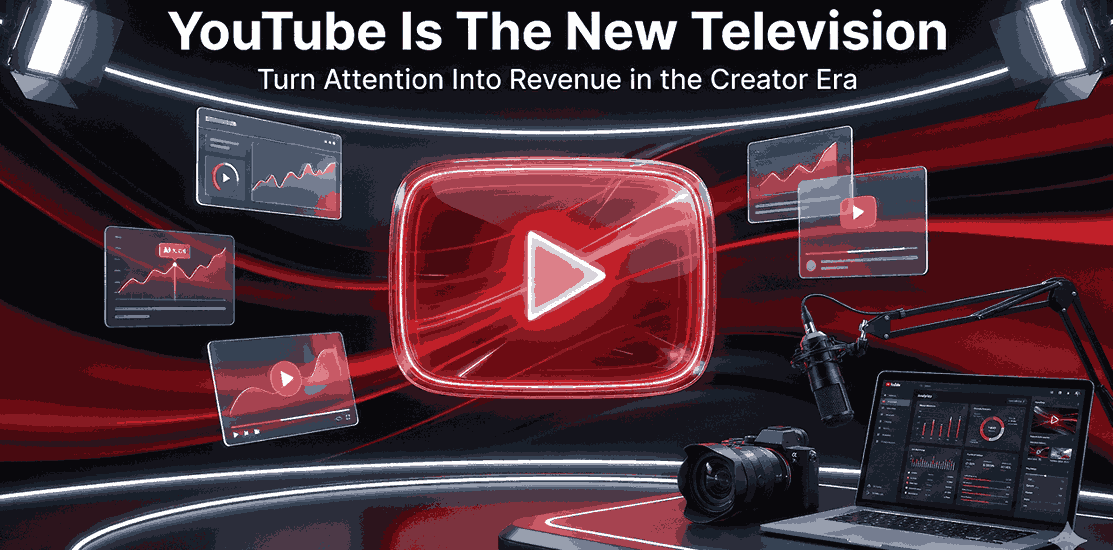
Once upon a time, television ruled the world. It created stars, sold dreams, and generated billions for networks and advertisers by monetizing our attention.
But that era didn’t die; it evolved. The golden age of television is alive… and it’s on YouTube.
If you understand how this new ecosystem works, you’ll unlock the same powerful engine that top brands and creators use to turn attention into real revenue.
Today, I’m breaking down why YouTube has replaced traditional TV, where ad dollars are really going, and most importantly, how you can leverage this shift to grow your business or influence.
Chapter 1: Why YouTube Replaced Television
For 70 years, TV worked the same way:
- Buy airtime
- Broadcast to millions
- Hope your message stuck
Advertisers paid millions for 30-second spots during Friends, the Super Bowl, or Seinfeld. They targeted broad demographics like “women 25–54” and crossed their fingers.
But here’s the problem: they never truly knew who was watching. Ratings were guesses, not guarantees.
Then came the internet.
- Cable exploded into hundreds of channels
- Streaming killed the linear TV schedule
- And now, AI-curated feeds deliver hyper-personalized content directly to our phones and living rooms
YouTube Isn’t Just a Platform, It’s a New TV Network
According to Nielsen, YouTube is now the #1 streaming service on TV screens in the U.S., outperforming Netflix, Hulu, and Disney+.
People aren’t just watching YouTube on phones anymore; they’re casting it to their 65-inch smart TVs. And they’re choosing it over traditional entertainment.
What makes YouTube different?
It didn’t win by being bigger. It won by being smarter.
Unlike Netflix or Hulu, which offer surface-level recommendations, YouTube understands user intent. People come to YouTube to:
- Find answers
- Solve problems
- Learn skills
- Discover passions
From a yoga instructor in rural Ohio to a mechanic showing how to replace an oil filter, YouTube democratized video. It turned curiosity into community.
And here’s the key insight:
Every YouTube viewer is an opt-in audience.
Whether it’s 100 million watching the Super Bowl or 100,000 watching a niche creator, they chose to be there.
That trust, that intent, that’s what makes YouTube audiences higher quality than any TV audience ever was.
With over 100 million active channels, YouTube is a universe of personalized “prime time” experiences, each curated by AI, built by creators, and fueled by real human interest.
Chapter 2: How People Actually Buy Today (And Why Most Advertisers Miss the Moment)
Ten years ago, the buyer’s journey was linear:
See ad → Visit store → Compare → Buy.
Today? It looks like a pinball machine:
- YouTube reviews
- Reddit threads
- TikTok demos
- Google Discover
- AI chatbots
There’s no straight path, just constant ricocheting across platforms until a decision clicks.
And video is at the heart of it.
- 50% of consumers watch online videos before buying (up from 34% in 4 years)
- 80% of U.S. viewers say YouTube helps them make more confident purchases (Canar Research)
Yet most brands still think in outdated funnels:
- Top of funnel: Blast awareness (TV, billboards, social)
- Bottom of funnel: Target searchers (“best air purifier”)
But here’s what they’re missing: the massive middle where real decisions happen.
The Hidden Buying Window: Before the Search
Google’s data reveals a game-changing insight:
70% of people who convert hadn’t searched for the brand in the past 30 days.
They weren’t on Google Search.
They were watching a cooking video… and saw an ad for an air purifier they’d researched days earlier.
YouTube knew they were still in-market even when they forgot.
By the time someone types your product into Google, the battle is already lost or won. Their shortlist is set. Their trust is assigned.
Your job? Be there before the search.
That’s where audience-based targeting on YouTube shines—reaching people based on behavior, not just keywords.
Chapter 3: Why YouTube Wins Where TV Failed
In the 1990s, Coca-Cola bought ads during Friends showing the same message to soda lovers, health nuts, and toddlers alike.
Massive reach. Zero relevance.
TV advertising was interruption-based:
- You disrupted the show
- Viewers waited impatiently
- Attention was borrowed, not earned
Today, that model is broken.
YouTube Is Built for Engagement Not Interruption
On YouTube:
- Users choose to open the app
- They come with intent, to learn, solve, or explore
- Even entertainment is topic-driven (gaming, finance, skincare, etc.)
And creators? They’re incentivized to hold attention – because they only earn when people watch.
So when your ad appears:
- It’s in a trusted context
- Next to relevant content
- In front of an engaged audience
This is why YouTube ads deliver 3x the brand lift as social media ads.
Old TV gave you reach without relevance.
Niche platforms offer relevance without scale.
YouTube delivers both.
Chapter 4: How to Find Your Next Customer on YouTube (Without Wasting Budget)
For years, mid-funnel targeting was broken:
- Broad interest targeting = wasteful
- Retargeting = too narrow (only reaches people who know you)
Enter Demand Gen Campaigns—Google’s answer to the modern buyer’s journey.
What Is a Demand Gen Campaign?
Demand Gen is a cross-platform ad format designed to reach people in the mid-to-lower funnel, even if they’ve never heard of you.
It runs across:
- YouTube Shorts
- YouTube In-Stream & Feed
- Google Discover
- Gmail
And it supports multiple creative formats in one campaign:
- 15-second videos
- 30-second videos
- Image carousels
- Headlines & descriptions
Google’s AI automatically formats and places your ads where they’ll perform best vertical for Shorts, horizontal for In-Stream, etc.
Real Results: How a Trade School Grew Leads on a Budget
One of our clients, a national trade schoo,l used Demand Gen to:
- Reach Gen Z via high-energy Shorts
- Target veterans around Veterans Day with patriotic testimonials
Results:
11% increase in student leads YoY
15% lower ad spend
32% lower cost per lead on paid search (thanks to boosted brand awareness)
You Don’t Need a Hollywood Budget
Worried about production costs? Don’t be.
Google’s built-in AI creative tools let you generate high-performing ads from just:
- Your logo
- A few brand images
- Short ad copy
Even small businesses can compete with national brands.
And the system adapts in real time:
- Casual browsers see inspirational content
- In-market buyers see pricing, CTAs, and urgency
You’re not broadcasting.
You’re engaging people at the exact moment they’re ready to decide.
The Bottom Line: YouTube Is the New Prime Time
The ad dollars that once built TV empires are now flowing to YouTube.
This isn’t just a trend, it’s a fundamental shift in attention, trust, and purchasing behavior.
Whether you’re a creator or a brand:
- Stop thinking in old funnels
- Start thinking in intent-based moments
- Use YouTube not just to reach people, but to serve them
The new television isn’t on your cable box. It’s in your pocket, on your TV, and built by millions of creators who understand their audiences better than any network ever did.
Ready to Launch Your First Demand Gen Campaign?
Google is offering $2,000 in ad credits when you spend $1,000 on your first Demand Gen campaign (U.S. only).
Offer valid through December 31, 2025, or while supplies last.
General FAQs
Yes. According to Nielsen, YouTube is now America's largest streaming platform on TV screens, ahead of Netflix, Hulu, and Disney. People are now “casting” YouTube to their smart TVs and preferring it over traditional TV or streaming.
Traditional TV has a broadcast model; the same content is shown to millions, whether they are interested in it or not. Every user on YouTube has a personalized, AI-curated feed. Here, the audience comes with intent to learn, compare, or solve a problem.
Yes. According to Google, YouTube ads generate 3x more brand lift than social media. Reason? The right mix of context, relevance, and scale. Your ad appears while the user is already engaged with the video content, not “interrupting” it.
Demand Gen is a Google ad campaign type that targets customers in the mid-to-lower funnel, even if they don't know about you. It runs on platforms like YouTube Shorts, In-Stream, Google Discover, and Gmail, and finds new people like your best customers with the help of AI.
Absolutely. Google's AI-based creative tools let you create automated video ads by simply uploading your logo, some images, and copy. Demand Gen campaigns deliver high-impact results even with small budgets, as one of our trade school clients achieved 11% more leads at 15% less spend.
